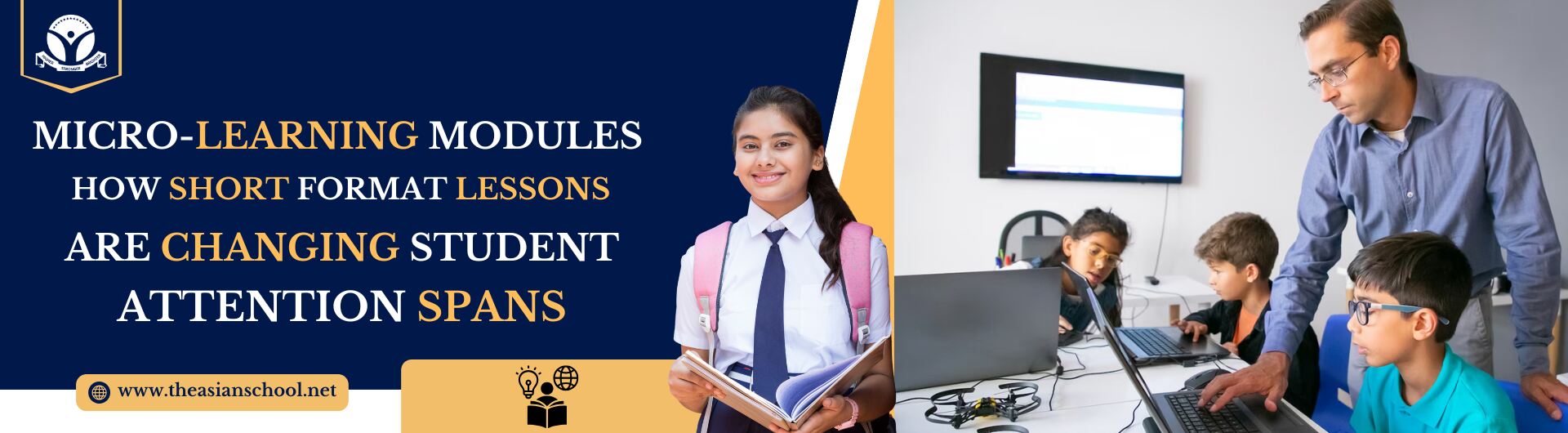


In today’s fast-paced, notification-driven world, the conventional classroom model, where a teacher lectures for an hour while students passively take notes, is facing a serious difficulty. Contemporary students, raised on the quick-fire content of the digital age, usually struggle to concentrate for long durations. This move in attention has resulted in a quiet revolution in education, specifically in forward-thinking institutions such as the boarding school in Dehradun, India – the rise of Micro-learning modules. These lessons of not more than 10 minutes duration, hence 2-minute lessons, aren’t a fad but a science lesson aimed at imparting powerful and concentrated knowledge that actually sticks. This article attempts to give a feel of how these short lessons are overcoming the challenge of the dwindling attention span of learners and making learning more effective.
- The Goldfish Attention Span – The Challenge Facing Education – Micro-learning Modules
The Goldfish Attention Span – The Challenge Facing Education – Micro-learning Modules
Decades of research and contemporary behavioral studies suggest that the human focus span, particularly when dealing with technical data, has dramatically decreased. Students are not accustomed to scrolling, switching apps, and absorbing data in short, extremely visual bursts.
For schools, particularly for a boarding school in Dehradun, where students should balance academics, extracurriculars, and residential life, this focus crisis presents a big hassle. Long, complicated lessons cause
1. Cognitive Overload – Too much new data at once overwhelms the brain, leading to it shutting down.
2. Decreased Retention – If a student’s mind wanders after 15 minutes of a 45-minute lesson, the majority of the material is lost.
3. Lack of Engagement – Lengthy, non-interactive lectures can cause boredom and disinterest, making the learning procedure feel like a chore.
The objective of contemporary pedagogy isn’t to fight this digital habit, but to take advantage of it. This is where the magic of Micro-learning starts.


What Exactly Are Micro-Learning Modules?
Micro-learning modules are easy, learning units developed to gain a single, particular goal in a very short amount of time.
Key features of Micro-learning –
1. Short Duration – Generally between 2 and 10 minutes.
2. Single Focus – Ease module targets one particular concept, skill, or truth.
3. Varied Formats – They utilize rich, involving media like –
- Short animated videos or explainer clips.
- Interactive quizzes or flashcards.
- Infographics or visual summaries.
- Short audio snippets or podcasts.
4. Accessibility – They are usually given technically, making them ideal for students in a residential school in Dehradun who have to study during breaks or prep time.
The Benefits – How Short-Format Lessons Boost Learning
Micro-learning is not about covering less material; it is about covering it smarter. By aligning lessons with the brain’s natural capability to concentrate, these short modules gain significant outcomes.
1. Improved Knowledge Retention
This is the most remarkable advantage. Research suggests that learning in short bursts, followed by a fast examination, assists in moving details from short-term to long-term memory.
- The Hack – Rather than a one-hour lecture on Photosynthesis, the teacher delivers three separate 7-minute videos over three days:
- 1-What is Photosynthesis?
- 2-The role of Chlorophyll.
- 3-The output products.
Each is followed by a 2-question quiz. This repeated exposure reinforces memory, dramatically decreasing the forgetting curve.
2. Higher Engagement and Motivation
Because the lesson is short, students understand the finish line is in sight. This decreases the mental obstacle to initiating the task.
- The Power of Completion – Finishing a 5-minute module provides students with a fast sense of accomplishment, which releases positive chemicals in the brain, inspiring them to begin the next module. This constant cycle of small wins keeps students in CBSE schools in Dehradun more inspired than slogging through a two-hour assignment.
3. Perfect for Self-Paced and Personalized Learning
In big classes, some students fall behind while others get bored. Micro-learning solves this.
- Targeted Review – A student struggling with a particular formula can rapidly rewatch a 3-minute video on just that formula, without having to examine a whole chapter or lecture.
- Gap Filling – For students returning to a boarding school in Dehradun after a break, micro-modules can be utilized as fast refreshers to make sure foundational knowledge is strong before moving on to the new topics.
4. Flexibility and Just-in-Time Learning
Micro-learning permits students to learn when and where they have to –
- A student in a residential school in Dehradun preparing for a debate competition can pull up a 4-minute module on Effective Persuasion Techniques right prior to the event.
- A student working on an experiment can instantly reference a short video on how to protectively manage laboratory tools. This immediate, appropriate access to details is extremely strong.
Micro-learning in Practice – The Modern Schoolroom
Reputable top 10 schools in Dehradun are incorporating micro-learning in a model named mixed learning, which merges the best of conventional teaching with technical innovation.
1. The Flipped Classroom Model –
Several schools are utilizing micro-learning to flip the classroom framework –
- The Homework – Students watch short, concentrated micro-videos prior to class.
- The Classwork – Class time is then committed to interactive activities, deep discussions, problem-solving, and hands-on projects, where the teacher works as a guide instead of a lecturer. This makes classroom time more productive and involved.
2. Gamification
Micro-quizzes and modules are frequently transformed into competitive games. Students earn points or badges for completing short tasks, fueling healthy competition and involvement among students at a residential school in Dehradun.
3. Remedial and Enrichment Tools
- For Strugglers – Micro-modules are automatically assigned to students who perform badly on a section, delivering a fast, concentrated review.
- For High-Achievers – Modern, 5-minute deep-dive modules are given to students who grasp the major thought rapidly, permitting them to explore related, high-level topics without waiting for the rest of the class.
The Balancing Act – Quality and Depth
While micro-learning is a strong tool, educators should utilize it wisely. Critics sometimes stress that so much concentration on short snippets of details may prevent students from growing the capability to engage in profound, sustained thinking, the skill required to solve complicated, real-world issues.
The key to quality educational institutions is balance.
- Micro-learning is utilized for knowledge acquisition.
- Conventional classroom time is utilized for critical thinking.
The objective isn’t to remove reading a textbook or listening to a discussion, but to utilize micro-modules to construct the basic knowledge in the most effective and involving way possible, freeing up useful class time for richer, profound learning activities.
The Future of Learning is Short and Focused
The focus span of the contemporary student has modified, and education should change with it. Micro-learning modules are leading this change, assisting hubs, The Asian School as the best boarding schools in India, to make sure that every minute of a student’s learning journey is useful, concentrated, and enjoyable. By breaking down the mountain of knowledge into manageable, bite-sized moves, we aren’t only housing shorter attention spans, but we are utilizing brain science to make learning more effective, more retained, and eventually, more successful.
Also Read : Skill-Based Education Beyond Exams – Preparing Students for Real-World Challenges